The night sky highlights a few very hot, luminous stars that stand out by color and brightness; spotting them helps tie constellations and open clusters to stellar evolution. Whether you scan with binoculars or a small telescope, these blue-hued stars mark important stages of massive-star lifecycles.
There are 13 Blue Giants, ranging from 17 Tauri (Electra) to Zeta Tauri, showing the variety of locations and contexts where these stars appear. For each entry you’ll find below the key fields organized as Spectral type, Apparent magnitude (V), Distance (ly), so you can compare temperature, visibility, and distance at a glance — see the list you’ll find below.
How are stars identified as blue giants?
Astronomers use spectra and luminosity to classify them: blue giants typically have O or B spectral types (very hot) and luminosity classes indicating larger radii than main-sequence stars. Spectroscopic lines, color indices, and measured brightness combine to place a star in that category.
Will I be able to see these stars from my backyard?
Many of the entries are bright enough for the naked eye under dark skies and most are straightforward with binoculars; a few fainter or more distant examples may need a small telescope. Check the Apparent magnitude (V) column in the list below to know what to expect.
Blue Giants
| Name | Spectral type | Apparent magnitude (V) | Distance (ly) |
|---|---|---|---|
| Bellatrix | B2III | 1.64 | 243.50 |
| Beta Centauri (Hadar) | B1III | 0.61 | 390.00 |
| Beta Crucis (Mimosa) | B0.5III | 1.25 | 353.00 |
| Mintaka (Delta Ori) | O9.5II | 2.23 | 915.00 |
| Iota Orionis | O9III | 2.77 | 1,325.00 |
| Lambda Orionis (Meissa) | O8III | 3.33 | 1,100.00 |
| Gamma Velorum | O7.5III | 1.78 | 336.00 |
| Kappa Scorpii | B1.5III | 2.41 | 430.00 |
| Zeta Tauri | B4IIIpe | 3.02 | 440.00 |
| Eta Tauri (Alcyone) | B7IIIe | 2.87 | 444.00 |
| 17 Tauri (Electra) | B6IIIe | 3.70 | 444.00 |
| Epsilon Canis Majoris (Adhara) | B2II | 1.50 | 430.00 |
| Beta Canis Majoris (Mirzam) | B1II-III | 1.98 | 500.00 |
Images and Descriptions

Bellatrix
Bright giant in Orion’s shoulder, Bellatrix is a B2III star visible to the naked eye at magnitude 1.64. About 243.5 light-years away, it’s notable for its blue-white color and role marking Orion’s left shoulder in winter skies.
Beta Centauri (Hadar)
Hadar (Beta Centauri) is a luminous B1III giant system forming one end of the Southern Cross. At magnitude 0.61 and roughly 390 light-years away, it’s one of the brightest southern-sky blue giants used for navigation in the south.
Beta Crucis (Mimosa)
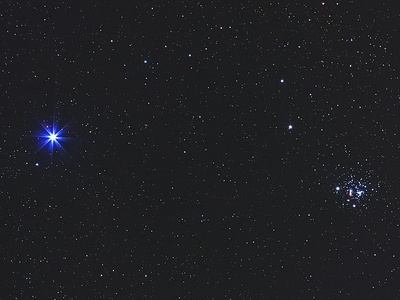
Mimosa (Beta Crucis) is a B0.5III bright giant shining at magnitude 1.25. Located around 353 light-years away in the Southern Cross region, it’s notable for its brightness, blue hue, and status as an early-type evolved massive star.
Mintaka (Delta Ori)
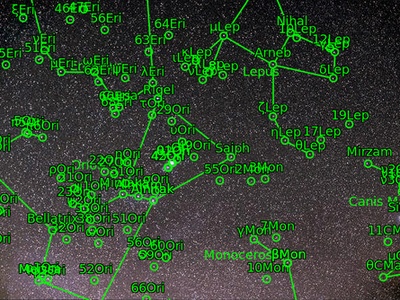
Mintaka (Delta Orionis) is an O9.5II bright giant forming one end of Orion’s Belt. At magnitude 2.23 and about 915 light-years away, it’s a multiple system whose hot, blue components make it stand out in winter skies.
Iota Orionis
Iota Orionis is an O9III giant marking the head of Orion’s Sword region. At magnitude 2.77 and roughly 1,325 light-years distant, it’s a massive, evolved star in a multiple system and a striking blue point in Orion.
Lambda Orionis (Meissa)
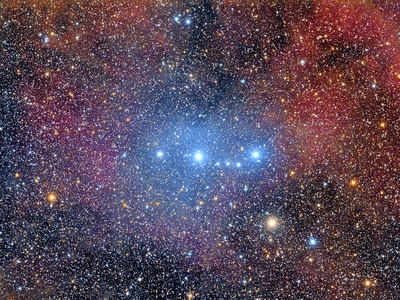
Meissa (Lambda Orionis) is an O8III blue giant forming Orion’s head. With magnitude 3.33 and sitting near 1,100 light-years away, it’s part of a young stellar grouping and shines with hot, blue-white light in winter skies.
Gamma Velorum
Gamma Velorum is a famous southern system whose bright O7.5III companion and a Wolf–Rayet partner produce a combined magnitude of 1.78. About 336 light-years away, its hot O-type component is a textbook example of an evolved massive giant.
Kappa Scorpii
Kappa Scorpii is a bright B1.5III giant in Scorpius, shining at magnitude 2.41. Roughly 430 light-years from Earth, it’s notable for its blue-white color, position in the Scorpion’s body, and membership in a multiple-star system.
Zeta Tauri
Zeta Tauri is a B4IIIpe emission-line giant notable as one of Taurus’s bright stars. At magnitude 3.02 and about 440 light-years away, it’s a Be star with a circumstellar disk, producing variable emission and a vivid blue-white appearance.
Eta Tauri (Alcyone)
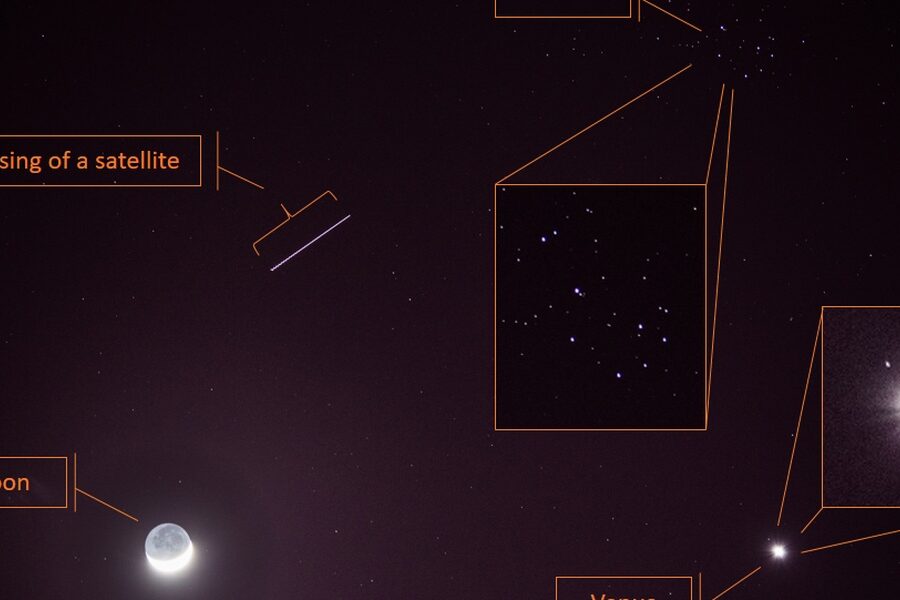
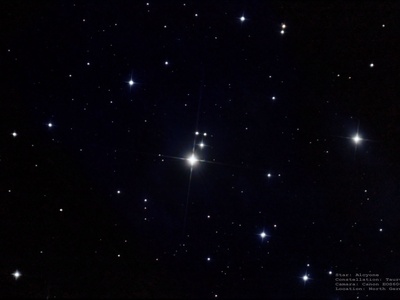
Alcyone (Eta Tauri) is the brightest Pleiad and a B7IIIe blue giant at magnitude 2.87. About 444 light-years away, it anchors the Pleiades cluster and displays emission-line behavior and a youthful, hot blue color.
17 Tauri (Electra)
Electra (17 Tauri) is a B6IIIe giant in the Pleiades cluster, magnitude 3.70 and roughly 444 light-years distant. As a young, blue giant, it helps define the cluster’s plume and often shows disk-related emission features in its spectrum.
Epsilon Canis Majoris (Adhara)
Adhara (Epsilon Canis Majoris) is a bright B2II bright giant at magnitude 1.50, lying about 430 light-years away. As one of the brightest stars in Canis Major, its hot blue light dominates winter southern skies near Sirius.
Beta Canis Majoris (Mirzam)
Mirzam (Beta Canis Majoris) is a B1II–III pulsating giant/bright giant at magnitude 1.98 and roughly 500 light-years away. Its intermediate luminosity class reflects its evolved state and it helps mark the winter sky near Sirius.