Across fields from nuclear chemistry to environmental monitoring, the different forms of an element can change how it’s detected, handled, and regulated. Understanding the isotopes of arsenic helps scientists track contamination, interpret decay data, and design lab experiments with the right safety and analytical expectations.
There are 32 Arsenic Isotopes, ranging from Arsenic-62 to Arsenic-92. For each, you’ll find the Mass number (A), Half-life, and Decay mode(s) organized so you can compare stability and decay pathways — details you’ll find below.
Which arsenic isotope is stable and which are long-lived radioactive ones?
Arsenic-75 is the only naturally stable isotope; the others are radioactive with half-lives that vary widely from fractions of a second to much longer periods. Consult the list below to see exact half-lives and decay modes for the longer-lived radioisotopes you might encounter.
How are arsenic isotopes used in research and monitoring?
Researchers use specific arsenic isotopes as tracers in environmental studies, to validate analytical methods, and in some radiopharmaceutical research; regulatory and remediation work relies on isotope-specific data to assess sources, transport, and risks.
Arsenic Isotopes
| Isotope | Mass number (A) | Half-life | Decay mode(s) |
|---|---|---|---|
| Arsenic-71 | 71 | 2.72 d | Electron capture (EC), beta+ |
| Arsenic-72 | 72 | 26.0 h | Beta+ (positron emission), electron capture |
| Arsenic-73 | 73 | 80.30 d | Electron capture |
| Arsenic-74 | 74 | 17.77 d | Electron capture |
| Arsenic-74m | 74 | 1.00 h | Isomeric transition (IT), electron capture |
| Arsenic-75 | 75 | stable | Stable (observationally) |
| Arsenic-76 | 76 | 1.08 d | Beta- |
| Arsenic-77 | 77 | 38.83 h | Beta- |
| Arsenic-77m | 77 | 5.20 s | Isomeric transition (IT) |
| Arsenic-78 | 78 | 1.60 h | Beta- |
| Arsenic-79 | 79 | 9.01 min | Beta- (beta-minus) |
| Arsenic-80 | 80 | 15.2 s | Beta- |
| Arsenic-81 | 81 | 32.8 s | Beta- |
| Arsenic-82 | 82 | 24.0 s | Beta- |
| Arsenic-83 | 83 | 13.4 s | Beta- (possible delayed processes) |
| Arsenic-84 | 84 | 5.8 s | Beta- (delayed neutron emission) |
| Arsenic-85 | 85 | 2.2 s | Beta- (delayed neutron emission) |
| Arsenic-86 | 86 | 720 ms | Beta- (delayed neutron emission) |
| Arsenic-87 | 87 | 350 ms | Beta- (delayed neutron emission) |
| Arsenic-88 | 88 | 200 ms | Beta- (delayed neutron emission) |
| Arsenic-89 | 89 | ~150 ms | Beta- (delayed neutron emission) |
| Arsenic-90 | 90 | ~100 ms | Beta- (delayed neutron emission) |
| Arsenic-91 | 91 | ~50 ms | Beta- (delayed neutron emission) |
| Arsenic-92 | 92 | ~30 ms | Beta- (delayed neutron emission) |
| Arsenic-70 | 70 | 52.6 s | Beta+ (positron emission), proton emission |
| Arsenic-69 | 69 | 15 s | Proton emission, beta+ |
| Arsenic-68 | 68 | ~50 ms | Proton emission |
| Arsenic-67 | 67 | ~20 ms | Proton emission |
| Arsenic-66 | 66 | ~10 ms | Proton emission |
| Arsenic-64 | 64 | ~4 ms | Proton emission |
| Arsenic-63 | 63 | ~1 ms | Proton emission |
| Arsenic-62 | 62 | <1 ms | Proton emission |
Images and Descriptions
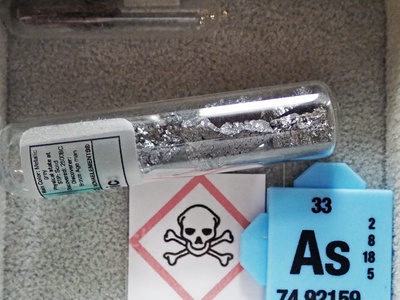
Arsenic-71
Produced in reactors and accelerators; useful as tracer in nuclear studies. Short-lived, decays by electron capture to germanium, interesting for studying nucleosynthesis pathways.

Arsenic-72
Made in cyclotrons via proton or deuteron reactions; used in research tracer studies and reaction cross-section measurements; notable for being proton-rich.
Arsenic-73
Long-lived radioisotope produced by irradiation of stable targets; used in laboratory studies of decay schemes and environmental tracing due to multiday half-life.
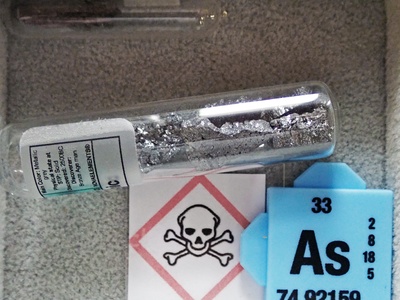
Arsenic-74
Commonly produced by neutron activation of selenium or charged-particle reactions; handy as a medium-lived tracer in material studies and decay-scheme investigations.
Arsenic-74m
Metastable excited state of As-74 observed in experiments; interesting for nuclear structure studies and short-lived spectroscopy.
Arsenic-75
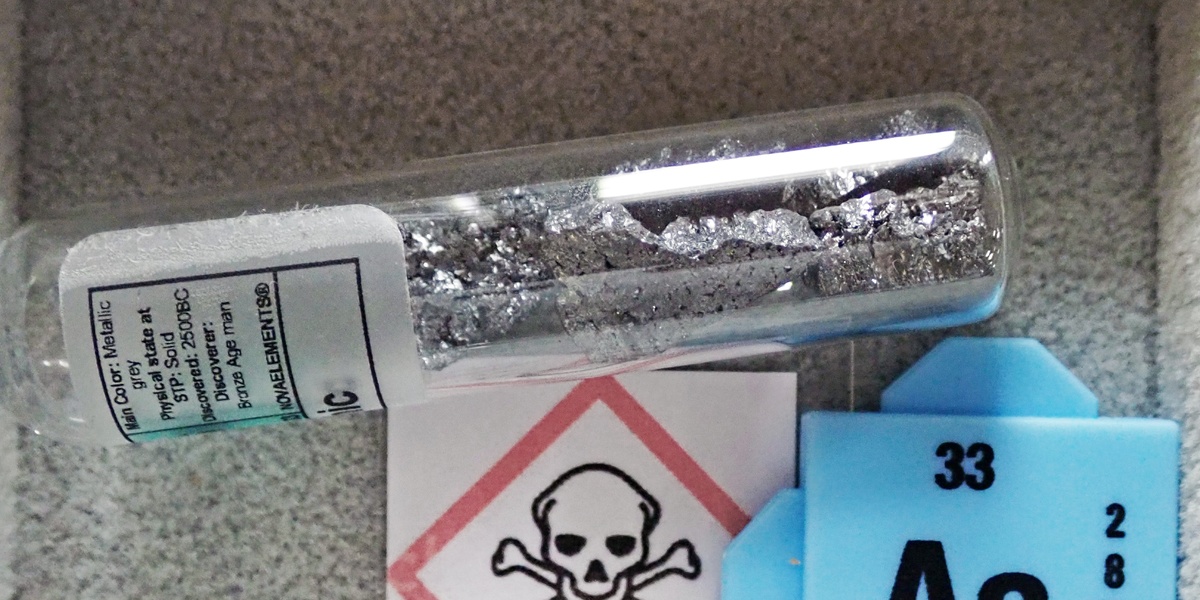
The only stable (observationally) isotope of arsenic and the naturally occurring form; central in chemistry, geochemistry, and biology; baseline reference for all arsenic isotope work.
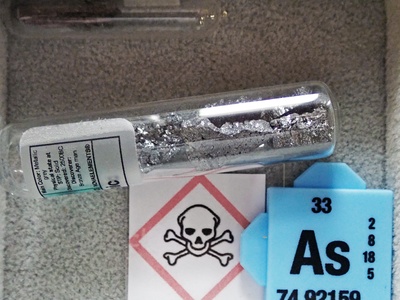
Arsenic-76
Produced in reactors and accelerators; decays by beta-minus and is used in nuclear data studies and to probe neutron-rich production routes.
Arsenic-77
Made by neutron activation and accelerator reactions; used in nuclear structure research and for calibrating detectors due to its convenient multi-day half-life.
Arsenic-77m
A confirmed metastable state of As-77 seen in experiments; useful for studies of nuclear excitation and gamma spectroscopy.
Arsenic-78
Synthesized in accelerators; short-lived and used for reaction-mechanism studies and mapping decay chains toward stable As-75.
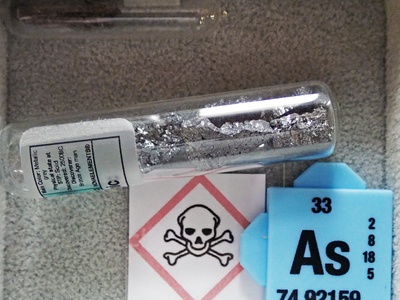
Arsenic-79
Produced in fragmentation and fission experiments; short half-life makes it useful for fast-timing nuclear experiments.
Arsenic-80
Very short-lived, produced in projectile fragmentation for nuclear-structure studies and to explore drip-line behavior.
Arsenic-81
Observed in radioactive-beam facilities; of interest for mapping beta-decay feeding and level schemes in neighboring nuclei.
Arsenic-82
Made in fragmentation reactions; helps probe shell effects far from stability and measure delayed neutron emission probabilities.
Arsenic-83
Short-lived nuclide produced in modern facilities; valuable for studying fast decay processes in neutron-rich regimes.
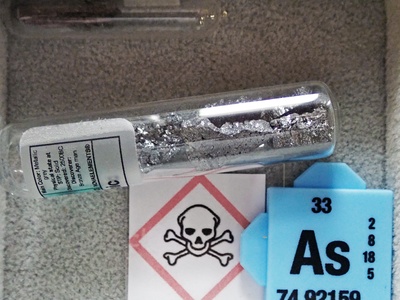
Arsenic-84
Produced in fragmentation; notable for neutron emission following beta decay, relevant to r-process nucleosynthesis modeling.
Arsenic-85
Very short-lived, observed in exotic-beam experiments; used to study decay properties and neutron-rich nuclear structure.
Arsenic-86
Approaches neutron drip-line; produced in high-energy fragmentation, interesting for nuclear astrophysics and decay-mode mapping.
Arsenic-87
Short-lived exotic isotope seen in fragmentation facilities; helps constrain theoretical models for neutron-rich matter.
Arsenic-88
Observed in specialized experiments; of interest for extreme neutron-rich behavior and decay-mode trends.
Arsenic-89
Produced with exotic beams; used to study rapid-decay chains and single-particle structure near drip line.
Arsenic-90
Very short-lived, produced only in high-energy facilities; valuable for theoretical tests of shell evolution.
Arsenic-91
Extremely short-lived, observed at fragmentation facilities; important for mapping the limits of nuclear stability.
Arsenic-92
One of the most neutron-rich observed arsenic isotopes; produced in rare-event experiments to probe drip-line physics.
Arsenic-70
Proton-rich and short-lived, created in fragmentation and radioactive-beam reactions; interesting for studying proton emission and mirror symmetry.
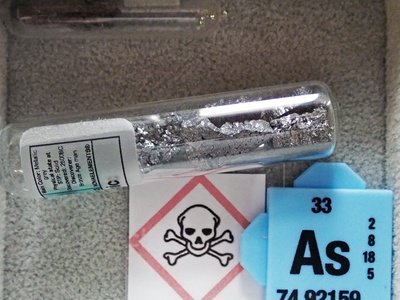
Arsenic-69
Very proton-rich, observed in projectile fragmentation; useful for exploring proton drip-line behavior and exotic decay modes.
Arsenic-68
Near the proton drip line; produced in specialized experiments and interesting for extreme proton-rich nuclear behavior.
Arsenic-67
Highly unstable, seen in advanced fragmentation setups; helps understand nuclear forces at the proton-rich edge.
Arsenic-66
Extremely short-lived and proton-unbound; observed in cutting-edge experiments studying direct proton decay.
Arsenic-64
One of the lightest observed arsenic nuclides; produced only in high-energy fragmentation, notable for immediate proton emission.
Arsenic-63
Marginally observed at the limits of detection; interesting primarily to nuclear physics specialists studying stability boundaries.
Arsenic-62
Rarely observed, effectively at the limit of experimental reach; of theoretical interest for drip-line mapping.